USCIS Q1 FY 2026 Trends: EB-1A Approval Rates Decline While NIW Sees Modest Improvement

USCIS has released its I-140 adjudication statistics for the first quarter of Fiscal Year 2026 (October–December 2025), providing valuable insight into how adjudication trends are shifting for two of the most popular self-sponsored employment-based immigrant categories: the EB-1A Extraordinary Ability petition and the EB-2 National Interest Waiver (NIW). The figures reflect petitions adjudicated during the quarter, regardless of when they were originally filed.
The latest data shows that the two categories moved in opposite directions. While EB-1A petitions experienced a decline in approval rates, National Interest Waiver petitions posted a modest improvement compared to the previous quarter.
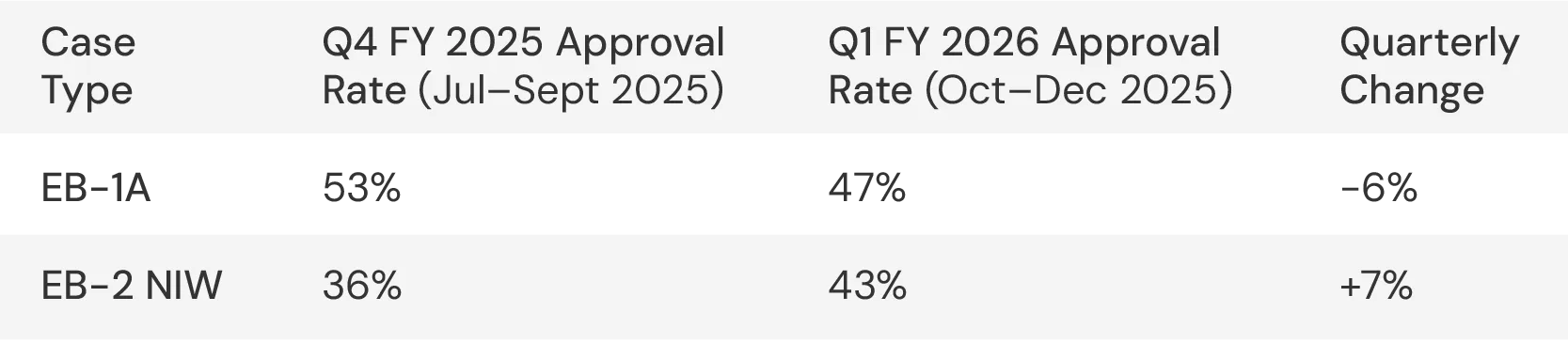
For EB-1A petitions, the approval rate declined from approximately 53% to 47%, representing a six-percentage-point decrease from the previous quarter. USCIS received 7,756 new EB-1A filings and completed 4,594 adjudications, approving 2,180 petitions while denying 2,414. The agency also reported a pending inventory of 24,653 EB-1A petitions.
Although a single quarter does not necessarily establish a long-term trend, the continued decline in EB-1A approvals suggests that USCIS remains highly selective when evaluating extraordinary ability petitions. Applicants should expect close scrutiny of both the quantity and quality of their evidence, particularly documentation demonstrating sustained national or international acclaim, original contributions, leadership, published material, and the overall impact of their work.
The National Interest Waiver category, by contrast, experienced a modest rebound. Approval rates increased from 36% in Q4 FY 2025 to approximately 43% in Q1 FY 2026, a seven-percentage-point improvement. During the quarter, USCIS received 13,829 new NIW filings and adjudicated 5,586 cases, approving 2,380 petitions while denying 3,206. Despite the improved approval rate, the agency’s pending inventory continued to grow, reaching 82,812 petitions.
The increase in NIW approvals may indicate somewhat greater consistency in adjudications following several challenging quarters. However, a 43% approval rate still reflects a demanding standard. Petitioners must continue to demonstrate that their proposed endeavor has substantial merit and national importance, that they are well-positioned to advance the endeavor, and that waiving the labor certification requirement would benefit the United States.
One notable takeaway from the latest statistics is that the gap between EB-1A and NIW approval rates has narrowed considerably. While EB-1A continues to maintain a slightly higher approval rate, the difference between the two categories is now only about five percentage points. At the same time, both programs continue to receive substantial filing volumes, with the NIW category carrying one of the largest pending inventories among all employment-based immigrant classifications.
These quarterly statistics should be viewed as a snapshot of USCIS adjudication activity rather than a predictor of outcomes for newly filed petitions, since many of the cases decided during Q1 were submitted months or even years earlier. Nevertheless, the data reinforces an important lesson for prospective applicants: regardless of category, success depends on presenting a well-documented, strategically organized petition that clearly satisfies the applicable legal standard.