U.S. to Expand Entry Restrictions on Nationals of 39 Countries Beginning January 1, 2026

In mid-December 2025, the White House announced a new travel restriction policy that will broaden limitations on foreign nationals entering the United States. Set to take effect on January 1, 2026, this expanded directive builds upon earlier restrictions put in place in June 2025, extending entry suspensions to citizens from a total of 39 countries as well as individuals traveling with travel documents issued by the Palestinian Authority (PA).
What the Expanded Restrictions Do
The latest proclamation divides affected countries into two categories:
- Full suspension: Nationals of certain countries will be barred from entering the U.S. in both immigrant and non-immigrant categories.
- Partial suspension: Nationals will be restricted from entering as immigrants and certain classes of nonimmigrants, but other visa categories may be subject to additional review and shortened validity.
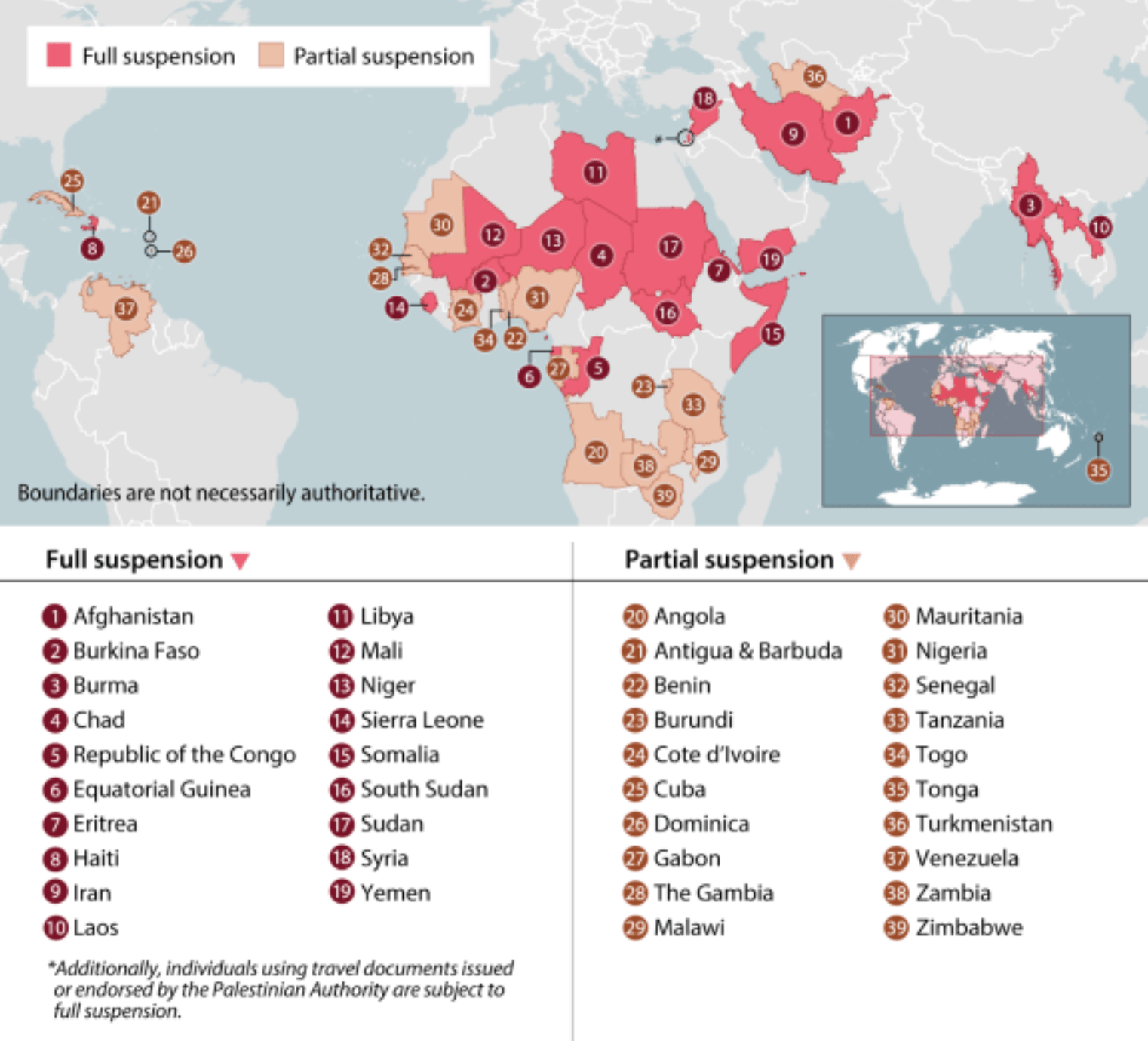
Eligibility for these restrictions applies to individuals who are outside the United States on January 1, 2026, and who do not already possess a valid visa. In practical terms, persons from the listed countries cannot re-enter the U.S. or begin new journeys to enter after this date without a qualifying visa.
Countries Under Full Suspension
The executive action maintains and expands a list of countries whose citizens face the strictest limitations. These include nations where the U.S. government has cited concerns related to terrorism, national security, public safety, and the exploitation of immigration systems. Nationals of the following countries will be fully barred from entering the United States:
Afghanistan, Burkina Faso, Burma, Chad, Republic of the Congo, Equatorial Guinea, Eritrea, Haiti, Iran, Laos, Libya, Mali, Niger, Sierra Leone, Somalia, South Sudan, Sudan, Syria, and Yemen.
Partial Suspension List
A second group of countries is subject to a partial suspension, where immigrant visas and certain temporary visas (including B-1/B-2 visitor visas, F student visas, M vocational visas, and J exchange visitor visas) are restricted. These countries include:
Angola, Antigua and Barbuda, Benin, Burundi, Côte d’Ivoire, Cuba, Dominica, Gabon, The Gambia, Malawi, Mauritania, Nigeria, Senegal, Tanzania, Togo, Tonga, Turkmenistan, Venezuela, Zambia, and Zimbabwe.
For these nationals, visa validity may be curtailed, affecting their ability to travel to the United States even if a visa is granted.
In updating the policy, some countries were reclassified between suspension categories. For example, Laos and Sierra Leone, which were previously subject to partial suspension, were moved to the full suspension list in the December proclamation.
USCIS Pauses Adjudications for Affected Nationals
In parallel with the expanded travel restrictions, U.S. Citizenship and Immigration Services (USCIS) has placed a temporary pause on adjudicating immigration benefit requests filed by nationals of the affected countries. Under recently issued internal guidance, USCIS will continue to accept and receipt petitions as normal, but it will not issue final approvals or denials for impacted immigrant or nonimmigrant cases while the pause remains in effect. This administrative hold is tied to a broader government review of screening and vetting procedures and does not reflect any deficiency or negative finding in an individual case. Importantly, cases are not denied—they are simply held in abeyance until USCIS completes its review and formally resumes adjudications. For many applicants, this means filings can still move forward procedurally, preserving priority dates and positioning cases to advance quickly once the pause is lifted.