Immigrant Visa Processing Suspended for 75 Countries: What You Need to Know

Summary
- The U.S. Department of State (DOS) has announced a suspension of immigrant visa (IV) processing for nationals of certain countries deemed “high risk” for public benefits usage.
- Impacted applicants may continue to submit immigrant visa applications and attend scheduled interviews, but no immigrant visas will be issued during the pause.
- The suspension does not apply to nonimmigrant visas, such as tourist (B-1/B-2) or student (F-1) visas.
- Individuals already in the U.S. with a pending adjustment of status (green card) application are not affected at this time.
- The DOS has not announced how long the suspension will last or what new screening standards will replace the current process.
- This is a developing situation, and future changes remain possible.
What the Department of State Announced
The U.S. Department of State recently announced a temporary suspension of immigrant visa processing for nationals of certain countries that it has identified as being at a higher risk of future reliance on U.S. public benefits. According to the DOS, this pause is intended to allow the government to reassess its immigrant visa screening and processing procedures.
It is important to emphasize that this announcement applies only to immigrant visas, not to all visas. Immigrant visas are issued to individuals who intend to live permanently in the United States and are the primary pathway to obtaining a green card through consular processing abroad.
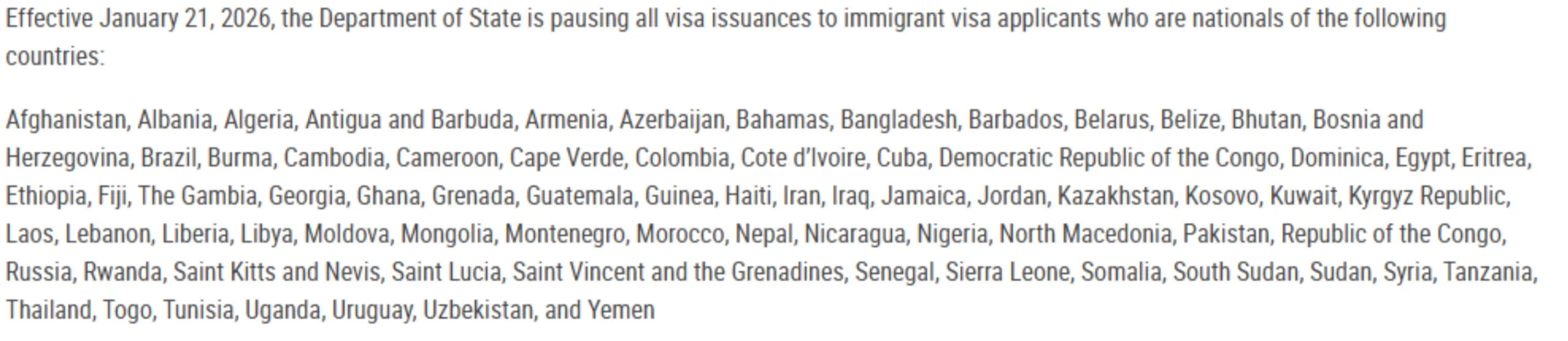
Source: travel.state.gov
Immigrant Visas vs. Nonimmigrant Visas
A great deal of confusion has already surfaced around this announcement, so understanding the distinction between visa categories is critical.
- Immigrant Visas (IVs):These are for individuals seeking permanent residence in the United States, such as family-sponsored or employment-based green cards processed through a U.S. embassy or consulate abroad.
- Nonimmigrant Visas (NIVs):These are temporary visas for a specific purpose, such as tourism, study, or short-term work. Examples include B-1/B-2 tourist visas and F-1 student visas.
At this time, nonimmigrant visa processing continues as normal. For example, impacted nationals may still apply for tourist and student visas, as this suspension does not affect those categories.
Who Is Not Impacted
First, individuals who are already in the United States and have filed an adjustment of status application—meaning they are applying for a green card from within the U.S.—are not impacted by this suspension under the current guidance. In other words, if someone is lawfully present in the U.S. with a pending green card application, their case should continue to be processed as normal, unless future policy changes are announced.
Second, the suspension does not apply to nonimmigrant visa categories, such as tourist (B-1/B-2) or student (F-1) visas. Nationals of affected countries may still apply for temporary visas for travel, study, or other qualifying short-term purposes.
Third, dual nationals are expressly exempt from this pause if they apply using a valid passport from a country that is not subject to the suspension. This means that individuals who hold citizenship in both a listed country and a non-listed country may continue with immigrant visa processing, provided they apply under the non-restricted nationality.
What Is the Government Trying to Accomplish?
According to the Department of State, the stated goal of this suspension is to reassess immigrant visa processing procedures in order to prevent the admission of individuals who are likely to rely on welfare or public benefits after entering the United States.
However, the announcement leaves several critical questions unanswered. The DOS has not explained what new standards or screening mechanisms will be used, nor has it clarified how public benefits risk will be evaluated once immigrant visa processing resumes.
What We Don’t Know Yet
As of now:
- The DOS has not confirmed how long the suspension will last.
- There is no published guidance on how embassies and consulates will screen immigrant visa applicants once the freeze is lifted.
- It remains unclear whether additional countries could be added or whether the policy could be expanded in scope.
Because of these uncertainties, this should be viewed as a developing story. More detailed guidance will be necessary before applicants and practitioners can fully assess the long-term impact.
What Should Applicants Do Now?
If you or your family members are in the process of applying for an immigrant visa through a U.S. embassy or consulate, it is important to understand how this pause will operate in practice.
According to the Department of State, immigrant visa processing itself has not stopped. Applicants who are nationals of affected countries may continue to submit immigrant visa applications, and embassies and consulates will continue to schedule and conduct immigrant visa interviews as normal. In other words, if you already have an interview scheduled—or are waiting for one to be scheduled—you should still prepare for and attend your appointment unless instructed otherwise by the embassy or consulate.
However, while interviews will continue, no immigrant visas will be issued to affected nationals during the pause. This means that even if an interview is completed successfully, the final visa issuance will be placed on hold until the suspension is lifted.
Importantly, this pause does not mean that your immigrant visa application has been denied. It is a temporary delay in visa issuance, not a negative adjudication on the merits of your case. Once the Department of State releases updated guidance and lifts the suspension, visa issuance may resume without requiring applicants to restart the process—though the exact mechanics have not yet been announced.
Given the uncertainty around timing and future screening standards, applicants should use this period to:
- Ensure all documentation is complete and accurate
- Monitor communications from the relevant U.S. embassy or consulate
Because the Department of State has not confirmed how long this pause will last or what new procedures will be implemented, applicants should expect continued developments. Staying informed and proactive is the best way to protect your immigration goals while this policy remains in effect.